
GORDON MATTA-CLARK
Brattleboro Festival of Miniatures
November 27, 2026 through January 10, 2027
A showcase feature and part of our Small Works exhibition
Mitchell • Giddings Fine Arts
181 Main Street, Brattleboro, VT
The Brattleboro Festival of Miniatures celebrates small scenes with big imagination, welcoming local artists, businesses, and visitors to share free, accessible experiences that spark creativity, foster community connection, and generate economic vitality throughout our region.
•••
Working Miniatures: Exhibition Model for Gordon Matta-Clark: Not the Work … The Worker
In the creation of large-scale visual art exhibitions, miniatures often play a crucial role in both their planning and execution. Mitchell•Giddings Fine Arts is giving you a special peek behind the curtain of the curatorial process by presenting the working miniature of the exhibition Gordon Matta-Clark: Not the Work … The Worker which is being held at the MAXXI Museum in Rome, Italy, from November 12th 2026 to February 28th 2027. The Director of the Estate of Gordon Matta-Clark, Jessamyn Fiore, used this very miniature to plan the layout of the large museum exhibition that she is curating along with the former MAXXI Museum Director Francesco Stocchi.
MGFA will present this 8-foot-long miniature that is a replica of Galleria 4 in this important Italian museum of 21st Century Art and Architecture. The museum building was originally designed by famed architect Zaha Hadid and the miniature captures its unique curved walls. Presented alongside the miniature will be images from the finished exhibition installation as well as original artworks by its subject, Gordon Matta-Clark.
Born in New York City in 1943, in the 1970s Gordon Matta-Clark experimented across various media and began staging interventions and installations in the charged city landscape, bringing attention to New York’s failing social policies, displaced people, and abandoned spaces. Through his many projects—including large-scale architectural interventions in which he physically cut through buildings slated for demolition—Matta-Clark developed a singular body of work that critically examined the structures of the built environment.
The Estate of Gordon Matta-Clark is a small family-run artist estate based in Chesterfield, New Hampshire, that was Founded by Jane Crawford, the artist’s widow, after Matta-Clark’s untimely death in 1978 at the age of 35. In 2012 Crawford’s daughter, Jessamyn Fiore, officially joined as Co-Director of the Estate and became Director in 2025. In addition to facilitating exhibitions, publications and projects about Gordon Matta-Clark, the Estate also supports the generation of new work by contemporary artists and other creatives in conversation with Matta-Clark’s practice and legacy.
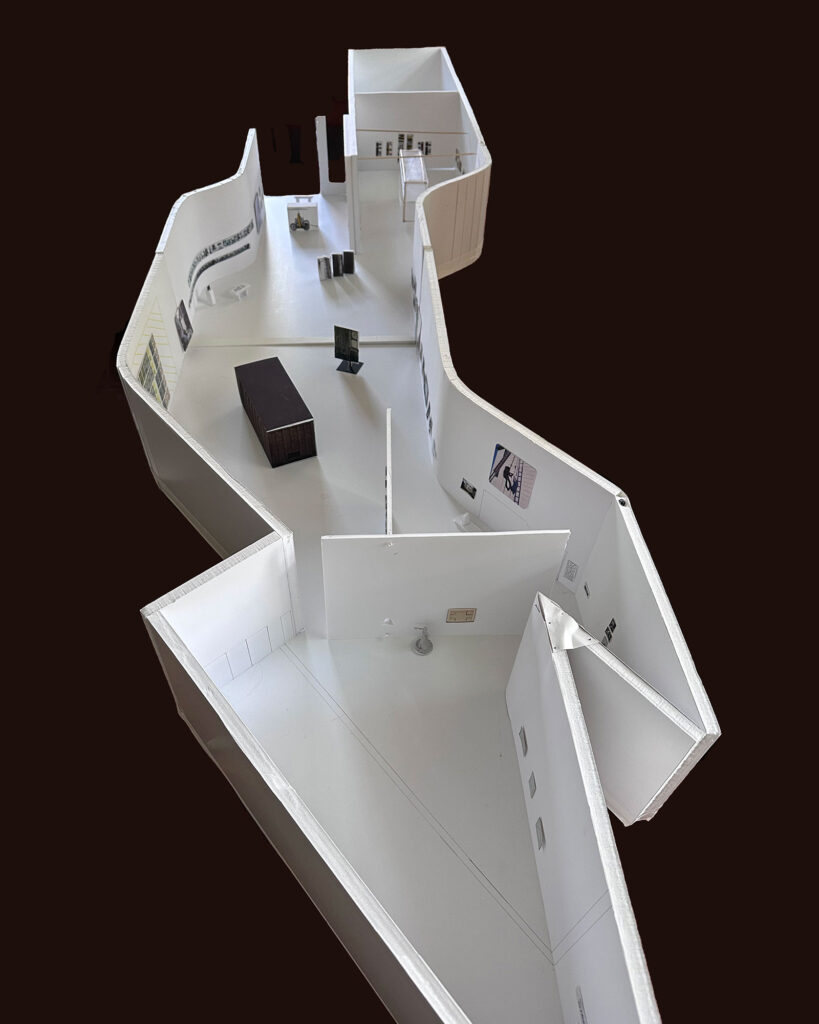
Exhibition Model for Gordon Matta-Clark: Not the Work … The Worker

Jessamyn Fiore
Jessamyn Fiore grew up between New York City and Chesterfield, New Hampshire, where she now resides. She is a contemporary art curator and writer as well the Co-Director of the Estate of Gordon Matta-Clark. After beginning her career as a playwright, she fell in love with working with artists as the Director of Thisisnotashop, a not for profit gallery space in Dublin, Ireland, from 2007-2010. After moving to New York City in 2010, she curated an exhibition about a legendary artist run space titled 112 Greene Street: The Early Years (1970-1974) at David Zwirner in New York (2011), which led to her editing the critically acclaimed, eponymous catalogue, published by David Zwirner and Radius Books (2012). She was the Curatorial Advisor for Rawson Projects in New York City (2014-2015, 2017-2018) and the curator of the Jean-Paul Najar Foundation in Dubai, UAE, from 2015-2017. She was a co-founder of Nasty Women Exhibition at the Knockdown Center, Queens, NY (January 2017).
Recent Exhibitions include Gordon Matta-Clark: Anarchitect at the Bronx Museum of the Arts, New York City (November 2017), co-curated with Sergio Bessa. The exhibition was critically acclaimed and subsequently toured to the Jeu de Paume, Paris, France (June 2018); Kumu Kunstimuuseum, Tallinn, Estonia (February 2019); and the Rose Art Museum at Brandeis University, Waltham, MA, (September 2019).
Current and Upcoming Exhibitions include Gordon Matta-Clark: Unravel the Unfound at KOS, Copenhagen, Denmark (opened June 2020) co-curated with Sergio Bessa; Leo Amino at The Black Mountain College Museum, Asheville, North Carolina (September 2021) co-curated with Genji Amino.
She graduated from Sarah Lawrence College in 2002 and received a Masters in contemporary art theory, practice, and philosophy from The National College of Art and Design, Dublin, in 2009.
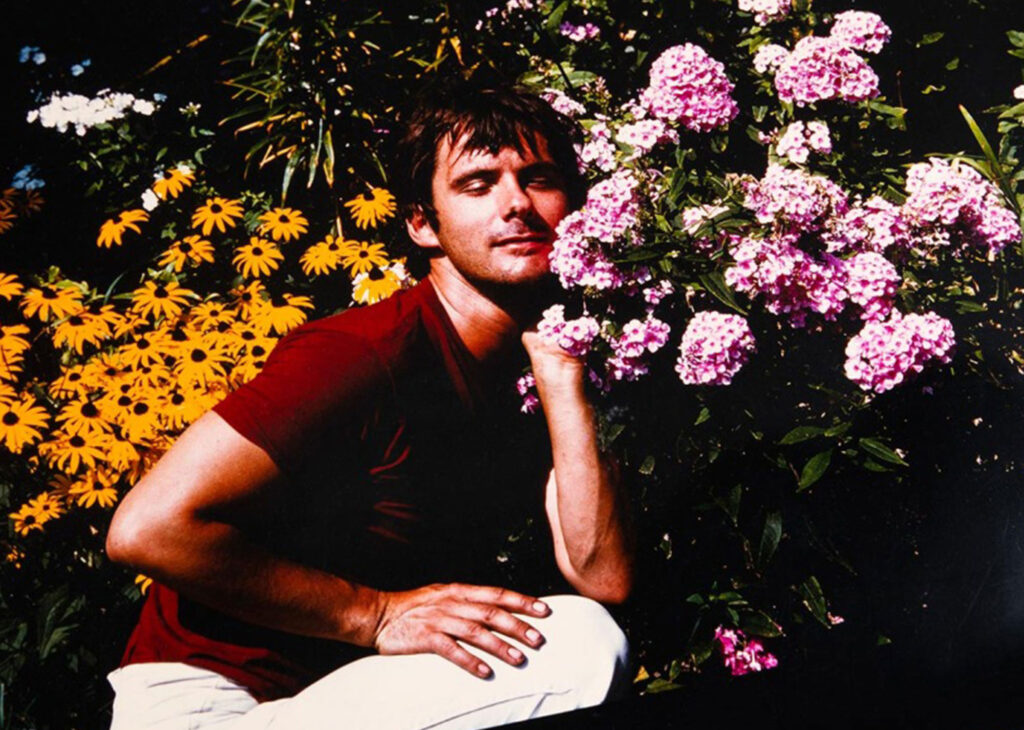
Gordon Matta-Clark, courtesy of the Estate of Gordon Matta-Clark
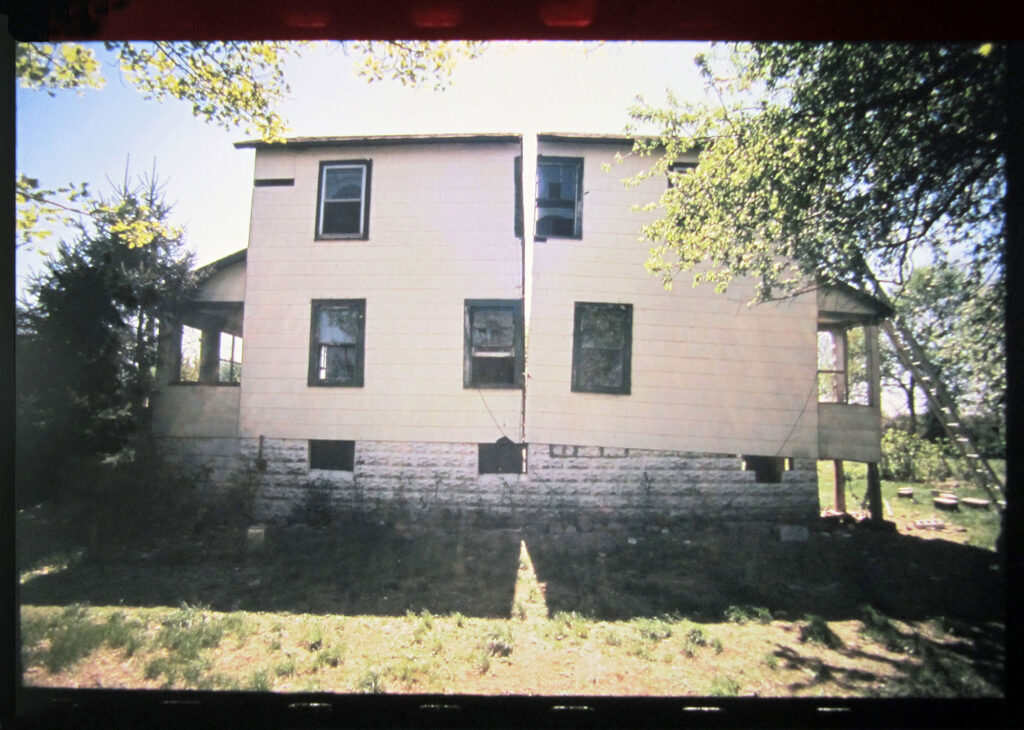
Splitting, 1974, courtesy of the Estate of Gordon Matta-Clark
A central figure of the downtown New York art scene in the 1970s, Gordon Matta-Clark (1943-1978) pioneered a radical approach to art making that directly engaged the urban environment and the communities within it, including large-scale architectural interventions in which he physically cut through buildings slated for demolition. His work transcended the genres of performance, conceptual, process, and land art, and made him one of the most innovative and influential artists of his generation. ~ David Zwirner, art dealer and owner of the David Zwirner galleries
•••
Gordon Matta-Clark is best known for bold, unconventional drawings, films, photographs, and sculptures relating to the built environment. The son of Surrealist painter Roberto Matta, he studied architecture at Cornell University from 1962-1968; there, he met sculptor Robert Smithson, whose interests in land art and the theory of entropy influenced him significantly. After completing his studies, he moved to New York and became a well-known figure among artists in the burgeoning avant-garde scene centered in Soho. Matta-Clark’s principal contribution was as a radical sculptor: he is recognized for his series of “building cuts” (1972-78), in which he carved out sections of entire structures, treating them as spatial compositions. Calling these transformations “Anarchitecture,” the artist documented them in films and photographs that were subsequently exhibited in galleries, often alongside fragments of the buildings themselves.
One of his most celebrated sculptures, Splitting, consisted of a vertical slice into an old frame house located in Englewood, New Jersey. The home, owned by New York art dealer Holly Solomon, was slated for demolition. The resulting film is composed of intentionally artless footage showing Matta-Clark and his friends making two parallel cuts down the center of the house; jacking up one half of the structure and beveling the cinderblock supporting it; and then lowering that half back down, bisecting the home and creating an ephemeral display of light inside the once-compartmentalized interior. The movie’s documentary style is the result of the artist’s dramatically physical approach to filmmaking. It reveals Matta-Clark as a daredevil, climbing around a structure that has nothing but a few jacks preventing it from collapse. The sequences, which study the light effects produced by the building cut, reveal a domestic space transformed into a sundial on a grand scale. ~ The Art Institute of Chicago
Mitchell • Giddings Fine Arts curates a diverse collection of innovative works that stimulate the seasoned collector and aesthetic explorer.